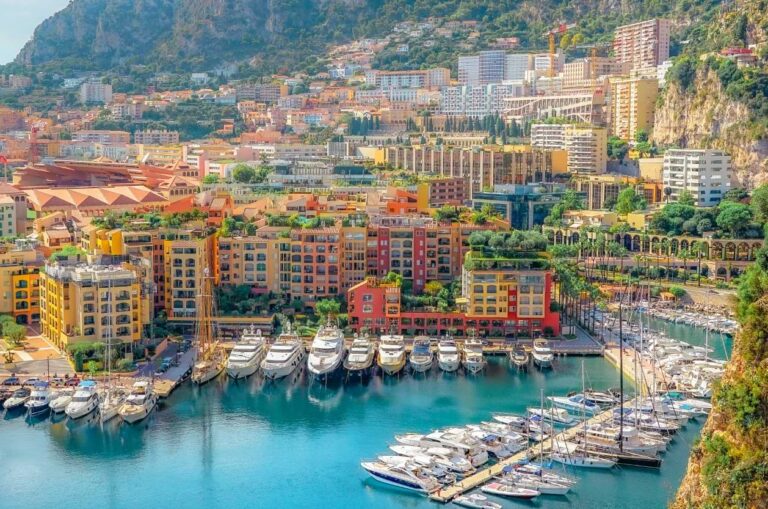
Renowned for its opulence and glamour, Monaco has also a long-standing tradition of banking, with its first private bank, the Société Générale de Banque, established in 1922.
The stable political environment and advanced banking services in the country have attracted numerous residents of Monaco, as well as non-residents, to utilize the banks in this small Principality for safeguarding and managing their assets.
For that reason, Monaco’s banking sector is dominated by private banking and wealth management, and there is a limited number of commercial banks offering retail services. The top banks in Monaco include UBP, Barclays Wealth, Societe Generale Monaco, Safra Sarasin, Bank Julius Baer, BNP Paribas Wealth Management, Credit Du Nord, Banque Edmond de Rothschild and Compagnie Monegasque de Banque.
In this guide, we will review the main characteristics of Monaco’s elite private banking sector.
NEW REPORT
The report “The definitive guide to living in Monaco” is now available, with detailed information on Monaco’s tax framework, residence and society.
Click here to download it for free.
Features of the Monegasque banking sector
The Monegasque financial system is highly developed and offers numerous advantages for individuals and businesses wishing to open a bank account and manage their funds in the most sophisticated ways with high security and confidence levels.
Monaco offers a range of advantages that many people and businesses are seeking, such as high-quality and personalized services, a high level of privacy, and reasonable fees.
High-quality services and personalized offers
Monaco has a highly developed and robust financial services sector, comprising 715 institutions operating in the financial and insurance sectors. Over the past decade, both the number of institutions and their revenues have seen significant growth. Official data indicates a 50% increase in the number of financial institutions and a 155% increase in their revenue, reflecting a high demand, diversified, competitive, and attractive offerings.
In keeping with its commitment to quality, Monaco has mandated since May 2023 that personnel working in banks and financial institutions must possess a certificate known as the Banking Professional Certification.
In addition to their traditional functions of accepting deposits and granting loans, banks in Monaco are highly innovative, offering a wide range of services such as portfolio management, advisory services, and order transmission and reception.
Monaco banks also provide a diverse array of products, including the sale of gold on deposit in financial instrument accounts. Moreover, the wealthiest clients benefit from personalized offers and services tailored to their specific needs and profiles.
The CCAF is the institution that regularly oversees banking entities to preserve the rights of the more than 90,000 clients of the Monegasque banking sector. To safeguard against false or misleading information, the list of authorized banks is published annually on the authority’s website.
Below is the comprehensive list of the 25 banks currently operating in Monaco as of 2025.
|
Monaco Banks List (2025) |
||
|
ANDBANK MONACO SAM |
BARCLAYS BANK PLC |
EFG BANK (MONACO) SAM |
|
BANCA POPOLARE DI SONDRIO |
BNP PARIBAS |
LA BANQUE POSTALE |
|
BANK JULIUS BAER (MONACO) SAM |
CAISSE D’EPARGNE ET DE PREVOYANCE DE LA COTE D’AZUR |
ROTHSCHILD & CO WEALTH MANAGEMENT MONACO |
|
BANK PICTET & CIE (EUROPE) AG |
CAISSE REGIONALE DE CREDIT AGRICOLE MUTUEL PROVENCE COTE D’AZUR |
SA LYONNAISE DE BANQUE – LB |
|
BANQUE HAVILLAND (MONACO) SAM |
CFM INDOSUEZ WEALTH |
SOCIETE GENERALE |
|
BANQUE J. SAFRA SARASIN (MONACO) SA |
CMB MONACO |
SOCIETE GENERALE PRIVATE BANKING |
|
BANQUE POPULAIRE MEDITERRANEE |
CREDIT LYONNAIS |
UBS (MONACO) SA |
|
BANQUE RICHELIEU MONACO |
EDMOND DE ROTHSCHILD (MONACO) |
UBP (UNION BANCAIRE PRIVEE) |
Monaco’s commitment to international financial standards
In June 2024, Monaco was placed on the Financial Action Task Force (FATF) “grey list” of jurisdictions under increased monitoring for strategic deficiencies in combating money laundering and terrorist financing. Monaco immediately responded with significant reforms and a comprehensive action plan.
Monaco’s progress and commitment:
The Principality has demonstrated strong commitment to addressing FATF concerns, implementing nine new laws in 2024 alone and establishing a unified Financial Intelligence Unit (FIU) with enhanced AML/CFT supervisory authority. In June 2025, the FATF-MONEYVAL plenary session acknowledged that Monaco had “largely addressed” the required actions within designated timelines—a rare commendation for a grey list jurisdiction.
Monaco’s National Strategy and Action Plan for 2025-2027 targets five critical areas: improving risk assessments for money laundering and tax fraud committed abroad, increasing requests to seize foreign criminal assets, strengthening sanctions for AML/CFT violations, enhancing the Financial Intelligence Unit with improved resources and suspicious transaction reporting, and streamlining judicial processes.
Timeline for grey list exit:
Monaco’s target date for removal from the FATF grey list is June 2026, with progress reviews conducted in May and September 2025. The Government of Monaco, under Minister of Finance and Economy Pierre-André Chiappori, has expressed confidence in achieving this goal, noting that 80% of deficiencies identified by MONEYVAL were addressed before the initial grey listing.
This ongoing commitment to international financial standards reinforces Monaco’s dedication to maintaining its position as a trusted, transparent financial center while preserving the high-quality banking services and confidentiality that have defined its banking sector for over a century.
Privacy
Monegasque banking is world-renowned for its confidentiality, stemming from its bank secrecy laws of 1931. It has high standards of confidentiality, to the point that bank employees are prosecuted when they fail to comply with strict privacy regulations.
That said, it must be remembered that Monaco is no longer a tax haven: since the implementation of the Common Reporting Standard (CRS) by the OECD and the Foreign Account Tax Compliance Act (FATCA) by the US, the Principality’s banks share information with the foreign authorities when there are suspicions of tax evasion, terrorist financing or money laundering.
Yes, to this day, the Monaco bank continues to be the benchmark for respect for privacy. To give an example, a Caribbean bank does not offer the same guarantees as a Monegasque bank. But that should not mislead you: the time when Monaco was an offshore country is very far away.
Monaco Banking Advantages vs Switzerland and Luxembourg
For international investors and high-net-worth individuals managing cross-border portfolios, Monaco’s banking sector offers distinct transactional advantages compared to Switzerland and Luxembourg.
Regulatory Independence
Monaco banks operate independently from the European Banking Authority (EBA), while Luxembourg banks fall under direct EBA supervision as an EU member state. This regulatory independence provides Monaco banks with greater flexibility in structuring bespoke solutions for international clients, though both jurisdictions maintain rigorous anti-money laundering standards and deposit protection schemes.
Securities Transaction Costs
Switzerland imposes stamp duties on securities transactions: 0.15% for Swiss securities and 0.30% for foreign securities. These charges apply to every buy and sell order executed through Swiss banks. Monaco levies no stamp duty on securities transactions, making it significantly more cost-effective for active portfolio management and frequent rebalancing.
For example, an investor with a €10 million portfolio executing €50 million in annual transactions through a Swiss bank would pay €150,000 in stamp duties annually. The same activity through a Monaco bank incurs zero transaction stamp duty.
Banking Confidentiality
All three jurisdictions comply with international transparency standards (CRS, FATCA), but Monaco maintains exceptionally strong banking confidentiality protections for legitimate financial activity. Switzerland’s banking secrecy has been significantly reduced under international pressure, while Luxembourg operates under EU banking directives requiring broader information sharing among member states.
Monaco’s century-old tradition of banking discretion, combined with its status as an independent principality, provides clients with a unique balance of transparency compliance and privacy protection.
Capital Movement Freedom
Monaco imposes no exchange controls or restrictions on capital movements, matching Switzerland’s traditional liberalism but contrasting with occasional EU-level restrictions that can affect Luxembourg accounts during financial crises or sanctions implementations.
Understanding Monaco Bank Deposit Requirements
Monaco’s private banking sector is stratified into distinct tiers based on minimum deposit requirements and the sophistication of services offered. While the Monegasque Association of Financial Activities (AMAF) recommends a baseline of €500,000 for non-resident account openings, actual requirements vary significantly across institutions.
Retail Banking Tier (€500,000 minimum)
Banks such as Société Générale Monaco, LCL (Crédit Lyonnois), and Compagnie Monégasque de Banque (CMB) may accept deposits starting at €500,000. These institutions offer comprehensive private banking services suitable for Monaco residents seeking the bank attestation required for residence permit applications. Services typically include portfolio management, property financing, and access to international investment products.
This tier serves primarily individuals establishing Monaco residency who need to meet the official financial sufficiency requirements without requiring the most exclusive wealth management services.
Mid-Tier Private Banking (€1,000,000 with €3,000,000 relationship commitments)
Institutions such as Andbank Monaco, Union Bancaire Privée (UBP), Safra Sarasin, and CMB Private Banking typically require minimum initial deposits of €1,000,000. However, these banks often expect clients to develop the relationship to approximately €3,000,000 over time through additional deposits, investment financing, or credit facilities.
This tier offers enhanced wealth management capabilities, including structured products, derivatives access, international tax-optimized vehicles (such as unit-linked life insurance), and dedicated relationship management with specialized expertise in cross-border wealth structuring.
Premier Private Banking (€3,500,000-€5,000,000)
Elite institutions including Barclays Private Bank Monaco, Edmond de Rothschild Monaco, and UBS Monaco typically require €3.5-5 million minimum deposits. These banks serve ultra-high-net-worth individuals and family offices, offering the most sophisticated wealth management solutions.
Services at this level include bespoke investment strategies, multi-generational wealth planning, art and collectibles financing, yacht and aviation financing, complex trust structures, and direct access to alternative investments including private equity and hedge funds. Clients benefit from dedicated teams rather than individual relationship managers, with specialists in tax, legal, and succession planning working collaboratively.
The Critical Importance of the Bank Attestation for Monaco Residency
For individuals seeking Monaco residency, the bank attestation (French: attestation bancaire) is a mandatory document proving sufficient financial resources. This official letter must be issued by a Monaco bank and dated less than one month old at the time of residency application submission to the Residents Section of Monaco’s Public Security Department.
The attestation confirms that the applicant maintains adequate funds to live in Monaco without recourse to employment or social assistance. The bank determines the sufficiency threshold based on the applicant’s profile, family size, and lifestyle expectations, typically aligning with the deposit tiers outlined above.
Critical timing considerations: Securing the bank attestation is often the longest step in the residency process. Banks require comprehensive due diligence—typically 2-6 weeks—before issuing the attestation. Choosing an inappropriate bank for your profile, or attempting direct applications without established relationships, frequently results in rejections that can delay your entire relocation timeline by months.
The attestation expires after 30 days, creating coordination challenges between bank account opening, property securing, and residency application filing. Professional guidance ensures these elements align properly to avoid missed deadlines or expired documentation.
Who is eligible to create a bank account?
Any Monegasque citizen, resident, or person in the process of relocating to Monaco, or a financial representative chosen by a candidate for an election, can open a bank account in the Principality with any bank of their choosing, under the outlined in Law No. 1.492.
This law was established in 2020 to guarantee the right of access to a banking account for Monegasque citizens and residents.
How about non-residents?
Can a non-resident open a bank account in Monaco? The answer is yes.
According to AMAF (The Monegasque Association of Financial Activities), 42% of banks’ resources come from non-resident clientele, originating from all European countries as well as Sub-Saharan Africa, the Middle East, Latin America, and Oceania. Since 2017, it is the AMAF that has recommended a single common threshold of €500,000 to all banks to open a bank account for non-residents.
Many banks, such as BNP Paribas Monaco, Société Générale, and HSBC Monaco, open accounts for non-residents.
According to the official website of the Principality of Monaco, to open a bank account, you need:
- Copy of a valid identification document.
- Copy of a proof of residence dated less than 3 months.
- A temporary receipt attesting to the submission of the residence permit (for new residents).
- A copy of an official document attesting to your activity (for business accounts).
Apart from these official documents, some banks may require you to justify your funds and financial situation, while others will want to know the reasons why you wish to open a bank account in Monaco.
The bank has a period of 15 business days, starting from the receipt of all necessary documents, to:
- Proceed with the opening of the bank account;
- Or issue you a refusal to open an account and inform you that you may appeal to the Budget and Treasury Directorate to designate a bank to open an account for you.
Monaco Relocation Group: Your Banking Partner
Monaco Relocation Group has spent years building trusted relationships with Monaco’s banking community. We understand each institution’s internal requirements, client preferences, and approval processes. Our banking assistance service ensures you secure the right account efficiently.
How we assist with Monaco banking:
- Bank matching: We analyze your financial profile, wealth sources, investment needs, and relocation timeline to recommend the optimal banking partner. Whether you need competitive property financing, sophisticated portfolio management, or simply reliable retail banking for your residence permit, we connect you with the appropriate institution.
- Application preparation: We ensure your documentation meets each bank’s specific internal requirements—not just the published guidelines—significantly reducing rejection probability and processing delays.
- Trusted introductions: We introduce you directly to relationship managers at our partner banks, providing the professional referral that prioritizes your application and accelerates due diligence.
- Coordination and timing: We synchronize your bank account opening with your property securing and residency application to ensure the bank attestation remains valid when needed, avoiding expired documentation and timeline delays.
- Rejection management: If complications arise, we quickly identify alternative institutions and adjust your approach, preventing the cascading delays that result from multiple failed attempts.
- Ongoing relationship support: After account opening, we assist with service upgrades, credit facility negotiations, or transitions to different institutions as your wealth management needs evolve.
Our established presence in Monaco’s banking sector gives our clients distinct advantages: priority processing, direct access to senior relationship managers, and insights into each bank’s current appetite for different client profiles.
Begin your Monaco banking journey with expert guidance.
Don’t risk delays, rejections, or mismatched banking relationships. Contact Monaco Relocation Group at [email protected] for a confidential consultation about your Monaco banking needs. We’ll assess your situation and provide clear guidance on the optimal path forward.
Sources:
- https://www.dataguidance.com/opinion/monaco-data-protection-financial-sector
- https://www.amaf.mc/fr/reglementations/secret-professionnel
- https://www.lefigaro.fr/conjoncture/2016/07/12/20002-20160712ARTFIG00260-bruxelles-signe-avec-monaco-un-accord-contre-le-secret-bancaire.php
- https://ccaf.mc/wp-content/uploads/2023/10/Rapport-Annuel-CCAF-2022.pdf
- https://legimonaco.mc/tnc/autre-texte-reglementaire/2023/[email protected]/
- https://ccaf.mc/en/list-of-authorised-firms-and-credit-institutions/
- https://monservicepublic.gouv.mc/thematiques/relations-avec-l-administration/protection-des-droits-et-mediation/compte-bancaire/ouvrir-un-compte-bancaire
- https://legimonaco.mc/tnc/loi/2020/07-08-1.492/
- https://www.amaf.mc/fr/qui-sommes-nous/la-place-financiere-monegasque
- https://www.fatf-gafi.org/en/countries/detail/Monaco.html
- https://www.fatf-gafi.org/en/publications/High-risk-and-other-monitored-jurisdictions/increased-monitoring-october-2025.html
- https://www.eba.europa.eu/
- https://www.petrini.mc/en/suisse-vs-monaco.html
- https://monservicepublic.gouv.mc/en/themes/nationality-and-residency/residency/new-entrants/how-to-apply-for-a-residence-permit
 All communications are encrypted and will be treated with absolute confidentiality. Your data will never be shared with third parties.